4Ts Score System for Heparin-Induced Thrombocytopenia

4Ts Score System assessment for Heparin-Induced Thrombocytopenia is an alternative evaluation tool prior to time-consuming antibody testing for HIT or empiric substitution of heparin for another anti-coagulant.
Platelet count fall 30–50% OR platelet nadir 10–19×109/l
Platelet count fall <30% OR platelet nadir <10×109/l
Clear onset between days 5–10 OR platelet fall ≤1 day (prior heparin exposure within 30 days)
Consistent with days 5–10 fall, but not clear; onset after day 10 OR fall ≤1 day (prior heparin exposure 30–100 days ago)
Platelet count fall <4 days without recent exposure
New thrombosis OR skin necrosis; acute systemic reaction post-IV heparin bolus
Progressive OR recurrent thrombosis; non-necrotizing skin lesions; suspected thrombosis (not proven)
None
None apparent
Possible
Definite
| Patient’s score | Range | Risk stratification | Probability of HIT | Recommendation |
|---|---|---|---|---|
| 0 | 0 | 0 | 0 | 0 |
Consider using the 4Ts scoring system 4Ts Score for Heparin-Induced Thrombocytopenia for:
- Differential diagnostic HIT and other causes of thrombocytopenia;
- Patients’ risk stratification for HIT in patients with thrombocytopenia who are currently or were recently on heparin derived agents.
| Thrombocytopenia | Platelet count fall >50% AND platelet nadir ≥20×109/l | +2 |
| Platelet count fall 30–50% OR platelet nadir 10–19×109/l | +1 | |
| Platelet count fall <30% OR platelet nadir <10×109/l | 0 | |
| Timing of platelet count fall | Clear onset between days 5–10 OR platelet fall ≤1 day (prior heparin exposure within 30 days) | +2 |
| Consistent with days 5–10 fall, but not clear; onset after day 10 OR fall ≤1 day (prior heparin exposure 30–100 days ago) | +1 | |
| Platelet count fall <4 days without recent exposure | 0 | |
| Thrombosis or other sequelae | New thrombosis OR skin necrosis; acute systemic reaction post-IV heparin bolus | +2 |
| Progressive OR recurrent thrombosis; non-necrotizing skin lesions; suspected thrombosis (not proven) | +1 | |
| None | 0 | |
| Other causes for thrombocytopenia | None apparent | +2 |
| Possible | +1 | |
| Definite | 0 |
Results evaluation:
4Ts Score System for Heparin-Induced Thrombocytopenia consisted of four criteria, each of which was worth 0, 1, or 2 points. To carry out stratification on the scale, it is necessary to summarize the obtained points.
| Score | Risk stratification | Probability of HIT |
| ≤3 points | low probability for HIT | ≤5% in original study, <1% in meta-analysis |
| 4-5 points | intermediate probability for HIT | ~14% |
| 6-8 points | high probability for HIT | ~64% |
Patients from the low-risk category frequently do not need further testing for HIT based on the assessment with 4Ts Score for Heparin-Induced Thrombocytopenia. Patients from the intermediate or high-risk groups require further laboratory evaluation for HIT or switching to a non-heparin-derived anti-coagulant.
Detailed parameters evaluation:
| Category | 2 points | 1 point | 0 points |
| Thrombocytopenia | Platelet count fall > 50% AND platelet nadir ≥ 20 ×109/l | Platelet count fall 30%–50% OR platelet nadir 10–19 ×109/l | Platelet count fall < 30% OR platelet nadir < 10 ×109/l |
| Timing of platelet count fall | Clear onset between days 5 and 10 OR platelet fall ≤ 1 day (prior heparin exposure within 30 days) | Consistent with days 5–10 fall, but not clear (e.g. missing platelet counts) OR onset after day 10 OR fall ≤ 1 day (prior heparin exposure 30–100 days ago) | Platelet count fall < 4 days without recent heparin exposure |
| Thrombosis or other sequelae | New thrombosis (confirmed) OR skin necrosis at heparin injection sites OR acute systemic reaction after intravenous heparin bolus | Progressive or recurrent thrombosis OR nonnecrotizing (erythematous) skin lesions OR suspected thrombosis (not proven) | None |
| Other causes for thrombocytopenia | None apparent | Possible | Definite |
Gold standard for diagnosis of HIT was either:
- A platelet serotonin release assay (SRA) and a PF4/polyanion-enzyme immunoassay (EIA) with ≥ 50% serotonin release and positive EIA, OR
- A positive heparin-induced platelet activation (HIPA) test in at least three of four donor platelets.
4Ts Score for Heparin-Induced Thrombocytopenia was developed based on the prospective studies in patients being evaluated for thrombocytopenia or suspected HIT in two clinical settings: inpatients at Hamilton General Hospital in Canada and various clinicians in a variety of healthcare settings in Germany and Austria. A subsequent review and meta-analysis of the 4Ts scoring system for HIT revealed that patients in the low-risk group had a negative predictive value of 0.998, irrespective of type of clinician, prevalence of HIT, or patient population. However, one of the four components of their scoring system, other causes for thrombocytopenia, is subjective.
Literature:
Lo GK, Juhl D, Warkentin TE, Sigouin CS, Eichler P, Greinacher A. Evaluation of pretest clinical score (4 Ts) for the diagnosis of heparin-induced thrombocytopenia in two clinical settings. J Thromb Haemost 2006; 4: 759–65. https://pubmed.ncbi.nlm.nih.gov/16634744/
Vatanparast R, Lantz S, Ward K, Crilley PA, Styler M. Evaluation of a pretest scoring system (4Ts) for the diagnosis of heparin-induced thrombocytopenia in a university hospital setting. Postgrad Med. 2012 Nov;124(6):36-42. https://pubmed.ncbi.nlm.nih.gov/23322137/
Register on our website right now to have access to more learning materials!

Simulation-Based Medical Education: BSMU Students in ClinCaseQuest Simulations (Video)
Simulation-based medical education is a key component of modern medical training. This video demonstrates how…
Three Research Directions Emerging from the ClinCaseQuest Simulation Study
ClinCaseQuest research reveals three key directions shaping medical education: psychological safety, clinical reasoning analysis, and…

Defragmented Debriefing Model as a Tool for Psychological Safety in Simulation Training
At the 6th International Scientific and Practical Conference “Medical Simulation: A Look into the Future”,…
Attempt-Based Analysis: A New Paradigm for Assessing Clinical Reasoning in Simulation
ClinCaseQuest is proud to highlight the presentation of Tetiana Antofiichuk, MD, PhD, at the international…
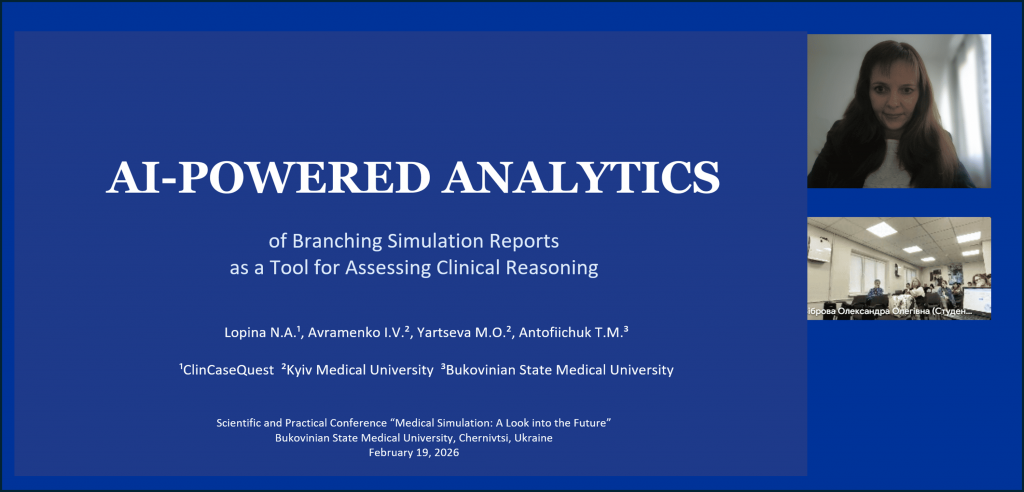
ClinCaseQuest presented the first experience of analyzing branching simulation logs based on artificial intelligence at the “Medical Simulation: A Look into the Future” Conference
ClinCaseQuest is pleased to share our participation in the scientific and practical conference “Medical Simulation:…

AI-Driven Patient Simulator – Quick Feedback
🗣️ We Value Your Feedback Thank you for your interest in the AI-Driven Patient Simulator!…