Charlson Comorbidity Index (CCI) Online Calculator


Charlson Comorbidity Index predicts 10-year survival in patients with multiple comorbidities.
| Variable | Points |
| Age | |
| <50 years | 0 |
| 50–59 years | +1 |
| 60–69 years | +2 |
| 70–79 years | +3 |
| ≥80 years | +4 |
| Myocardial infarction History of definite or probable MI (EСG changes and/or enzyme changes) | +1 |
| Congestive heart failure Exertional or paroxysmal nocturnal dyspnea and has responded to digitalis, diuretics, or afterload reducing agents | +1 |
| Peripheral vascular disease Intermittent claudication or past bypass for chronic arterial insufficiency, history of gangrene or acute arterial insufficiency, or untreated thoracic or abdominal aneurysm (≥6 cm) | +1 |
| Cerebrovascular accident or Transient ischemic attack History of a cerebrovascular accident with minor or no residua and transient ischemic attacks | +1 |
| Dementia Chronic cognitive deficit | +1 |
| Chronic obstructive pulmonary disease | +1 |
| Connective tissue disease | +1 |
| Peptic ulcer disease Any history of treatment for ulcer disease or history of ulcer bleeding | +1 |
| Liver disease Severe = cirrhosis and portal hypertension with variceal bleeding history, moderate = cirrhosis and portal hypertension but no variceal bleeding history, mild = chronic hepatitis (or cirrhosis without portal hypertension) | None 0 |
| Mild +1 | |
| Moderate to severe +3 | |
| Diabetes mellitus | None or diet-controlled 0 |
| Uncomplicated +1 | |
| End-organ damage +2 | |
| Hemiplegia | +2 |
| Moderate to severe chronic kidney disease Severe = on dialysis, status post kidney transplant, uremia, moderate = creatinine >3 mg/dL (0.27 mmol/L) | +2 |
| Solid tumor | None 0 |
| Localized +2 | |
| Metastatic +6 | |
| Leukemia | +2 |
| Lymphoma | +2 |
| AIDS | +6 |
Charlson Comorbidity Index assess by addition of the selected points:
| Variable | Definition | Points |
| Myocardial infarction | History of definite or probable MI (EKG changes and/or enzyme changes) | 1 |
| Congestive heart failure | Exertional or paroxysmal nocturnal dyspnea and has responded to digitalis, diuretics, or afterload reducing agents | 1 |
| Peripheral vascular disease | Intermittent claudication or past bypass for chronic arterial insufficiency, history of gangrene or acute arterial insufficiency, or untreated thoracic or abdominal aneurysm (≥6 cm) | 1 |
| Cerebrovascular accident or transient ischemic attack | History of a cerebrovascular accident with minor or no residua and transient ischemic attacks | 1 |
| Dementia | Chronic cognitive deficit | 1 |
| Chronic obstructive pulmonary disease | – | 1 |
| Connective tissue disease | – | 1 |
| Peptic ulcer disease | Any history of treatment for ulcer disease or history of ulcer bleeding | 1 |
| Mild liver disease | Mild = chronic hepatitis (or cirrhosis without portal hypertension) | 1 |
| Uncomplicated diabetes | – | 1 |
| Hemiplegia | – | 2 |
| Moderate to severe chronic kidney disease | Severe = on dialysis, status post kidney transplant, uremia, moderate = creatinine >3 mg/dL (0.27 mmol/L) | 2 |
| Diabetes with end-organ damage | – | 2 |
| Localized solid tumor | – | 2 |
| Leukemia | – | 2 |
| Lymphoma | – | 2 |
| Moderate to severe liver disease | Severe = cirrhosis and portal hypertension with variceal bleeding history, moderate = cirrhosis and portal hypertension but no variceal bleeding history | 3 |
| Metastatic solid tumor | – | 6 |
| AIDS* | – | 6 |
Plus 1 point for every decade age 50 years and over, maximum 4 points.
Note: liver disease and diabetes inputs are mutually exclusive (e.g. do not give points for both “mild liver disease” and “moderate or severe liver disease”).
*This data is from the original Charlson study in 1987, before the widespread availability of effective antiretroviral therapy. Currently, there are no any re-evaluations of the CCI using more recent data.
10-year survival = 0.983^(e CCI × 0.9), where CCI = Charlson Comorbidity Index.
Register on our website right now to have access to more learning materials!
Subscribe to our pages:
Literature:
- Charlson ME, Pompei P, Ales KL, MacKenzie CR: A New Method of Classifying Prognostic Comorbidity in Longitudinal Studies: Development and Validation. Journal of Chronic Diseases 40:373-383, 1987
- Quan H, Li B, Couris CM, Fushimi K, Graham P, Hider P, Januel JM, Sundararajan V. Updating and Validating the Charlson Comorbidity Index and Score for Risk Adjustment in Hospital Discharge Abstracts Using Data From 6 Countries. Am. J. Epidemiol. (2011)doi: 10.1093/aje/kwq433
- Radovanovic D, Seifert B, Urban P, Eberli FR, Rickli H, Bertel O, Puhan MA, Erne P; AMIS Plus Investigators. Validity of Charlson Comorbidity Index in patients hospitalised with acute coronary syndrome. Insights from the nationwide AMIS Plus registry 2002-2012. Heart. 2014 Feb;100(4):288-94. doi: 10.1136/heartjnl-2013-304588. Epub 2013 Nov 1.
- Zavascki AP, Fuchs SC. The need for reappraisal of AIDS score weight of Charlson comorbidity index. J Clin Epidemiol. 2007;60(9):867-8.

Simulation-Based Medical Education: BSMU Students in ClinCaseQuest Simulations (Video)
Simulation-based medical education is a key component of modern medical training. This video demonstrates how…
Three Research Directions Emerging from the ClinCaseQuest Simulation Study
ClinCaseQuest research reveals three key directions shaping medical education: psychological safety, clinical reasoning analysis, and…

Defragmented Debriefing Model as a Tool for Psychological Safety in Simulation Training
At the 6th International Scientific and Practical Conference “Medical Simulation: A Look into the Future”,…
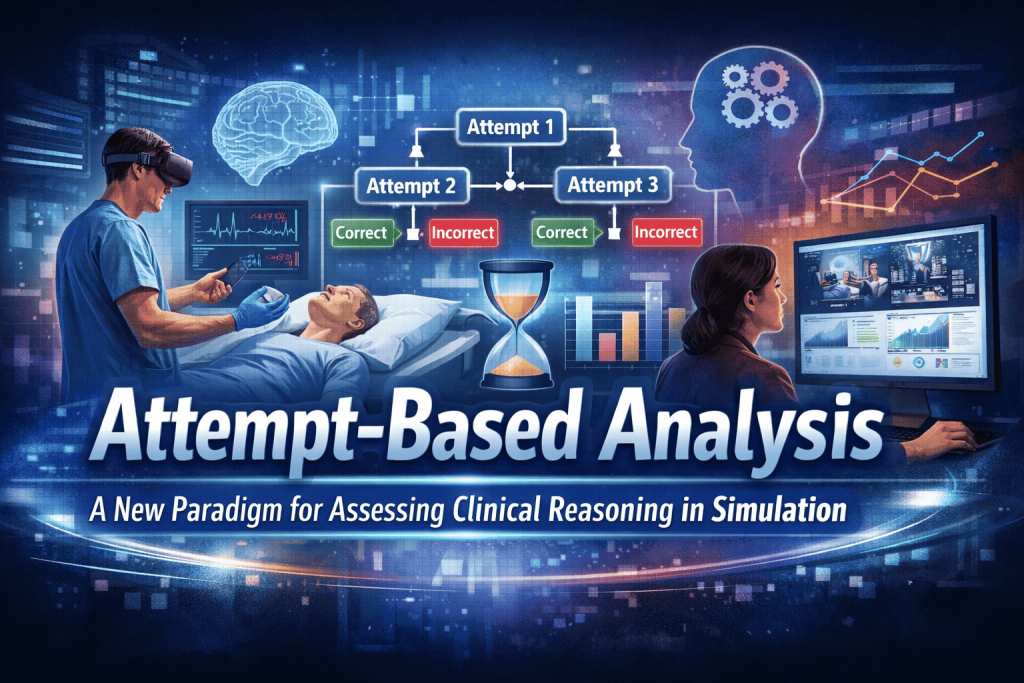
Attempt-Based Analysis: A New Paradigm for Assessing Clinical Reasoning in Simulation
ClinCaseQuest is proud to highlight the presentation of Tetiana Antofiichuk, MD, PhD, at the international…
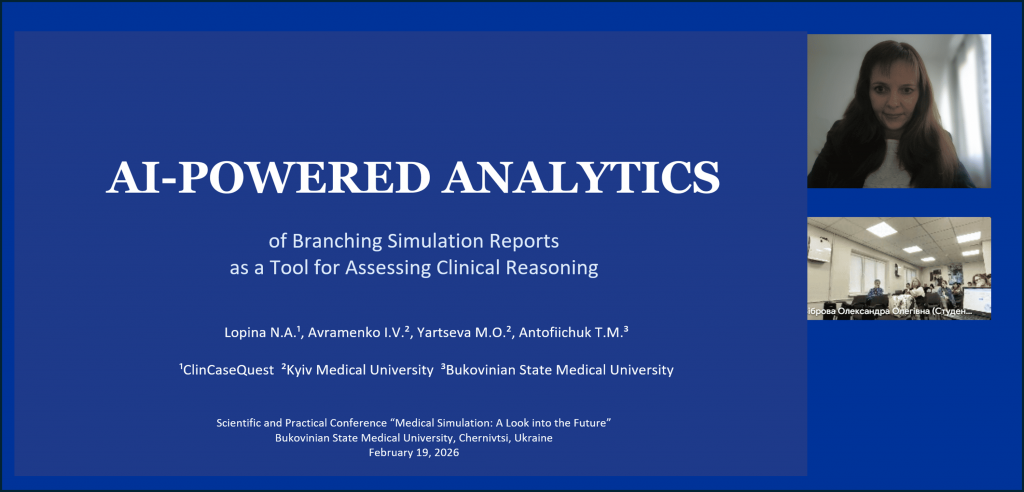
ClinCaseQuest presented the first experience of analyzing branching simulation logs based on artificial intelligence at the “Medical Simulation: A Look into the Future” Conference
ClinCaseQuest is pleased to share our participation in the scientific and practical conference “Medical Simulation:…

AI-Driven Patient Simulator – Quick Feedback
🗣️ We Value Your Feedback Thank you for your interest in the AI-Driven Patient Simulator!…